JUNE 2026 • RACHEL MANY
Creative Motherhood in the Age of Optimization
(Sent From My iPhone at School Pickup)
In a design landscape restructuring around artificial speed, the cost of caregiving is treated like operational drag.

My creative breakdown happened the way most things in my life do these days. The dishes were done. The kids were finally asleep. The blue light glow of my laptop sat open in a house that had gone, mercifully, quiet. I was fresh off yet another week month of sending resumes and proposals into the digital abyss of automated replies and unanswered emails.Despite whatever labor statistics metrics may say, the job market is in the shitter. Everything is expensive and everyone is exhausted. And somewhere between the pervasive LinkedIn “hot takes” and carefully polished optimism, there is a very real collective groan rippling through our creative industry now. The design workforce is shrinking, leadership roles are hardening, and the blunt force of AI era "efficiency" feels suspiciously like redundancy.For a long time, I tried to convince myself that my professional bruising was just a rough patch, a numbers game, or a temporary glitch in the matrix. Surely this strange market unraveling would eventually pass? But the longer I sit with it, a larger question becomes increasingly harder to ignore: Why does this moment feel so specifically punishing as a mother? I’ve spent the last decade-plus as a designer. On paper, the title is 'creative director,' though my imposter syndrome and an acute wave of internal cringe make me hesitate to claim it. Still, the reality remains: I’ve built brand ecosystems from the ground up, sold concepts to rooms full of skeptics, managed teams, embedded myself in agency culture, and run an independent studio. I’ve been doing this long enough to know the title is earned, even if saying it out loud still feels a bit like a dare.
I have also carried the relentless grind of family life in my head at all times: the rigid choreography of pickup times, the endless avalanche of school forms and newsletters about themed dress-up days, the grocery logistics, the school lunches, the birthday party circuits, the maddening mystery of vanishing socks (seriously, where do these tiny little things go? Is someone eating them?), the child who gets sick at the exact hour a meeting is scheduled, and the calendar that constantly needs tending.
I don't say this purely as a complaint, though to be clear, yes I am complaining a little. It is simply the reality of how much operational labor women are expected to absorb invisibly, and how little of that reality fits neatly inside the architecture of professional ambition.
Because the truth is, the convergence of all these pressures compounds far more heavily for mothers in the same creative work, whether anyone admits it aloud or not.

Economists call this the “motherhood penalty,” a term used to describe what happens when a woman's professional trajectory bends the moment she becomes a parent. It is measured not just in momentum, but in literal currency. According to a December 2025 analysis from the Institute for Women’s Policy Research, mothers working full-time, year-round earned only 74.3 cents for every dollar earned by fathers, shaped by childbirth-related time away from work, unequal caregiving labor, and limited workplace support. Their earnings continue to decrease an estimated 5 to 7% per child, on average.

But much of this penalty is more subtle, driven by the currency of perception. We are routinely perceived as less dependable, are evaluated more harshly in hiring, and passed over for promotion more frequently. One landmark audit study found that childless women received more than twice as many callbacks as equally qualified mothers, despite identical resumes. Mothers are held to higher punctuality standards than fathers, while simultaneously being offered lower starting salaries and few opportunities to advance.
Fathers, by contrast, often receive what researchers call the “fatherhood premium:” a documented increase in perceived competence, authority, and earnings. The same life event is priced entirely differently depending on who is living it. And if that doesn't infuriate you like a mother, I don't know what does.
To add insult to injury, motherhood rarely arrives at a neat, convenient checkpoint in a woman’s career. For myself, and many women like me, the years our careers are supposed to accelerate are the exact years we begin to start families. We put in the unglamorous grunt work required to climb the ladder, only to have our hard-earned professional progress collide with the non-negotiable reality of our own biological clock.

To be clear, I am deeply obsessed with my children and would choose them again instantly. But parenthood still remains a choice women continue to absorb disproportionately, professionally and otherwise.  According to McKinsey and LeanIn’s recent 2025 Women in the Workplace study, a quarter of women opting out of promotions cite caregiving obligations, while women with partners still remain three times more likely than men to handle the bulk of domestic work.
Even remote work—often a vital lifeline for balancing these duties—is a double-edged sword. According to the same study, “women working from home face a harsh 'flexibility stigma' and are far less likely to be promoted, whereas men who work remotely face no such penalty.”
But the statistics don't capture the exhausting performance of pretending otherwise. We are trapped in a culture that loves to tell us we can have it all, then reframes the eventual burnout as a personal failure rather than a predictable lack of support. The modern creative market thrives on the appearance of total spontaneity. It relies on you to cruise through job interviews and client pitches looking entirely unburdened, while you quietly shove the messy realities of caregiving into the corners of your day.Last year, more than 450,000 women left the workforce entirely—the sharpest non-pandemic decline in over forty years.

The irony is that these same creative mothers are often the very people most practiced in the skills leadership claims to value. Mothers operate daily inside overlapping systems of logistics, negotiation, endurance, resource allocation, emotional regulation, and real financial responsibility. (I will take my grave that no CEO understands how to prioritize competing deadlines against a rigid nap schedule quite like a mother.) We are already running a masterclass in operational excellence, just in a different register.The New Creative Economy
What makes the current creative landscape feel especially unforgiving is that this old bias is colliding with a new, ruthless contraction.

By the end of 2025, the agency world had entered yet another consolidation cycle. Omnicom cut over 4,000 jobs following its IPG acquisition. Combined with earlier cuts and mergers, roughly 10,000 positions were eliminated in a single year. Longstanding agencies like DDB, FCB, and MullenLowe were folded into larger holding structures under the guise of simplification.  Reuters also reported in February that WPP is consolidating Ogilvy, VML, and AKQA under a new “WPP Creative” umbrella to optimize efficiency and better deploy AI tools.

Nowadays, the teams do not entirely disappear; they thin. One role becomes two. Two become five. The expectations quietly metastasize. Suddenly, a single person is expected to be a Swiss Army knife of concepting, writing, prompting, strategizing, and designing. The pace is relentless, matched only by the exhausting expectation that you keep up with it enthusiastically.
For mothers, however, the same domestic labor that compresses our working hours also compresses our capacity to adapt to an industry reinventing itself in real time. There is no surplus time to play with shiny new tools, fail at them safely, and build the fluency now required for survival. Motherhood, it seems, makes you logistically complicated in a creative field that has run completely out of slack.
From the inside, this doesn’t feel like one isolated problem. It feels like a dozen separate systems collapsing inward all at once. It is not enough that mothers already carry the old, unwritten professional penalties attached to caregiving. We are now also being asked to continuously justify our value inside a contracting market that uses technology to force people to carry the weight of entire departments. The creative already perceived as a logistical liability becomes even easier to pass over.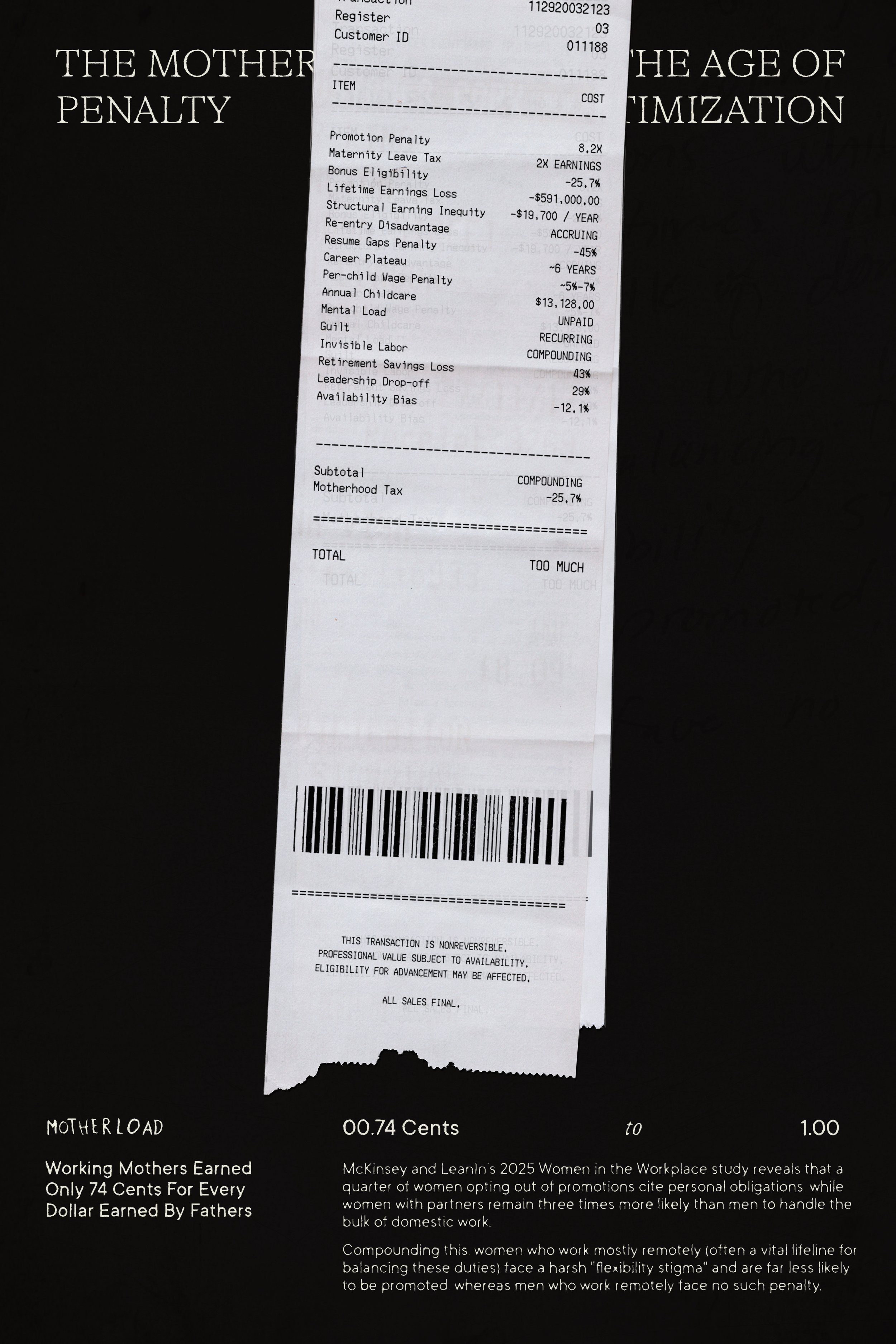
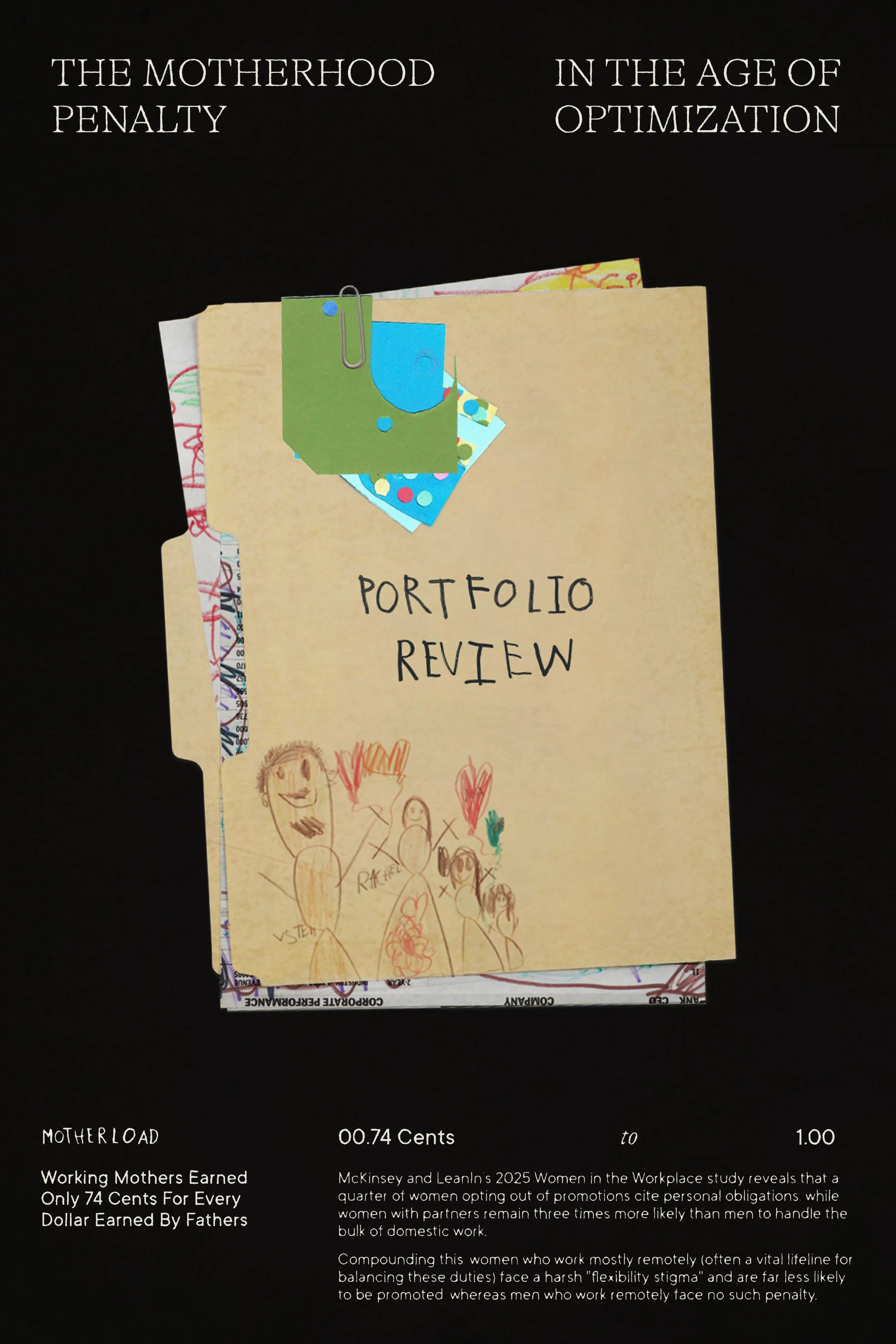
I'm not interested in flattening this into a simple complaint or a neat little rallying cry. The internet is already drowning in panic pieces about AI-induced creative doom. (Yes, I’m fully aware of the hypocrisy as I add to the pile, thank you very much.) The truth is, I am genuinely excited by many of these tools. I want to adapt, learn, and leverage them to expand my own craft.

What I am trying to say, mostly to reassure myself and other women quietly feeling the same thing, is that this sense of devaluation is not imagined. It is structural, and the hard-won progress of the last four decades is actively rolling back. The motherhood tax itself may not be new, but what does feel newly acute is how many taxes are now being levied at once. And for mothers trying to lead creatively while also contributing fiscally, emotionally, and logistically to their households, the cost becomes cumulative. The real question isn't whether mothers are still penalized. It’s how much longer an industry in freefall can afford to keep treating the people most skilled at managing complexity as though they are the ones least suited to lead.
SOURCES
Budig, Michelle J., and Sharyn Alfonsi. 2014. “The Fatherhood Bonus and The Motherhood Penalty: Parenthood and the Gender Gap in Pay.” Third Way. https://www.thirdway.org/report/the-fatherhood-bonus-and-the-motherhood-penalty-parenthood-and-the-gender-gap-in-pay.
Chatterjee, Mrinmoyee. 2025. “Equal Pay in 2025: Gender Gaps Increased, Forecast for Achieving Pay Equity Bleaker - IWPR.” Institute for Women's Policy Research - IWPR. https://iwpr.org/equal-pay-in-2025-gender-gaps-increased-forecast-for-achieving-pay-equity-bleaker/.
Correll, Shelley J., Stephen Benard, and In Paik. 2007. “Getting a Job: Is There a Motherhood Penalty?” American Journal of Sociology 112 (no. 5): 1297–1338.
McConnell, Megan. 2025. “Women in the Workplace 2025 report.” McKinsey. https://www.mckinsey.com/capabilities/people-and-organizational-performance/our-insights/women-in-the-workplace.
Thomas, Daniel. 2025. “Omnicom to axe historic ad agencies and cut 4,000 jobs in IPG takeover.” Financial Times. https://www.ft.com/content/2642490e-0de8-4b8a-b9de-59b5ea43e740?syn-25a6b1a6=1.
“WPP to revamp creative structure under new CEO, FT reports.” 2026. Reuters. https://www.reuters.com/business/wpp-overhaul-creative-agency-structure-strategic-shift-ft-reports-2026-02-09/.